Product Overview
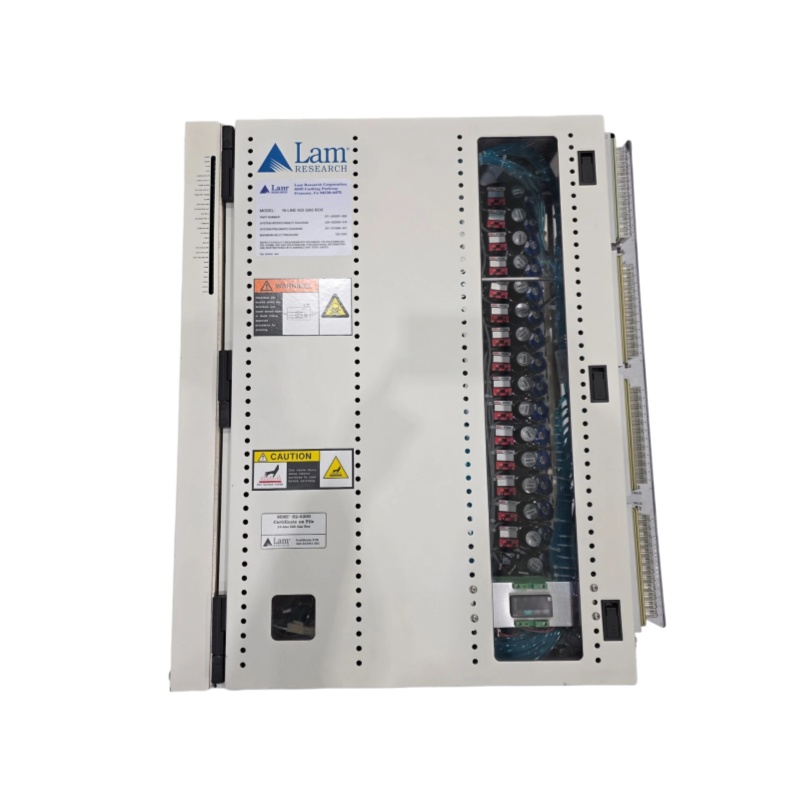
The Lam Research 571-033051-002 is a high-performance RF generator module specially designed for high-density plasma etching processes, serving as a core source-end device in the RF transmission system of Lam Research semiconductor manufacturing equipment. Its primary function is to convert industrial-frequency AC input power into highly stable and pure high-frequency RF power output, providing precisely controllable energy for gas ionization, decomposition and plasma maintenance within process chambers.
In etching processes, the amplitude stability, frequency accuracy and harmonic content of the RF power output by this module directly determine plasma density, ion energy distribution, as well as the final etching rate and uniformity. Adopting an advanced switching amplification topology, the module integrates high-efficiency power amplifier stages, precision frequency synthesis and phase-locked loop circuits, multi-stage output filtering networks, and comprehensive fault detection and protection circuits.
Seamlessly interfaced with the equipment main controller via a high-speed communication bus, the module receives power setting and enable commands from the upper computer, and real-timely feeds back critical operating parameters including forward output power, reflected power, operating temperature and amplifier status. For modern 300mm wafer manufacturing, its outstanding power output accuracy and fast dynamic response provide indispensable energy support for critical etching processes at 7nm and below nodes, directly affecting device yield and overall equipment effectiveness (OEE) of production lines.
Product Specifications
|
Parameter Name
|
Parameter Value
|
|
Product Model
|
571-033051-002
|
|
Manufacturer
|
Lam Research
|
|
Product Type
|
RF Generator Module
|
|
Output Frequency
|
13.56 MHz ± 0.005% (ISM Band)
|
|
Maximum Output Power
|
3000 W (Continuous Wave Mode)
|
|
Power Output Accuracy
|
±1% of set value (full scale range)
|
|
Input Voltage
|
380-480 VAC, 3-phase, 50/60 Hz
|
|
Output Interface
|
7/16 DIN Coaxial Connector
|
|
Communication Interface
|
High-speed RS-485 / Ethernet (Supports Lam Link Protocol)
|
|
Cooling Method
|
Water Cooling (Flow Rate: 6-8 L/min, Water Temperature: 20-25°C)
|
|
Operating Ambient Temperature
|
10°C to 40°C (Non-condensing)
|
|
Physical Dimensions
|
Approx. 480mm × 260mm × 650mm (W × H × D)
|
|
Installation Method
|
Dedicated Slide Rail Mounting in Equipment Cabinet
|
Structure and Composition
The internal structure of the Lam Research 571-033051-002 is designed strictly based on high power density, high electromagnetic compatibility (EMC) and easy maintainability principles. Its enclosure is made of thick aluminum alloy sheet metal with conductive oxidation treatment, delivering excellent RF shielding performance and structural strength. The front panel is equipped with a high-quality LCD display and membrane keys for local parameter viewing and debugging, as well as multi-color LED indicators to intuitively display the module’s operating status.
The internal space is reasonably divided by metal partitions into three independent areas: power amplification unit, control and signal processing unit, and input power filtering unit. Shielding structures are adopted between each area to minimize mutual electromagnetic interference.
In the power amplification link, the 3-phase AC input first passes through a power input module with surge suppression and EMI filtering, then is rectified and boosted by a high-power-density switching power supply to form a stable DC bus voltage. The core power amplification stage adopts an advanced LDMOS (Lateral Diffused Metal Oxide Semiconductor) transistor push-pull amplification architecture. Featuring high efficiency, high gain and superior broadband characteristics, this architecture amplifies RF excitation signals to the rated output power level.
The amplified RF signals eliminate high-order harmonics through a multi-stage low-pass and band-pass filtering network, then are output to the load via a directional coupler. The control system adopts a collaborative architecture of high-performance ARM processor and FPGA: the FPGA undertakes ultra-low-latency digital protection and feedback control, while the ARM processor is responsible for communication protocol parsing, system status management and data logging. The module is also integrated with a precision water-cooled heat dissipation system. The internal micro-channel liquid cooling flow path efficiently dissipates heat generated by power amplifier transistors, ensuring thermal stability under continuous high-power output conditions.
Key Features and Advantages
1. Excellent Power Output Accuracy and Stability
Equipped with an excitation source based on Direct Digital Synthesis (DDS) technology and closed-loop power control algorithm, the Lam Research 571-033051-002 supports fine power adjustment with 1-watt stepping across the full scale range. It maintains ultra-high stability and repeatability during complex power sequence changes in process recipes, including stepped power ramping and pulse modulation modes.
The module achieves a power output time drift of less than ±0.5% per hour and a temperature drift better than ±1% across the entire operating temperature range. It provides highly consistent RF energy input for high-precision etching processes, effectively reducing process deviation and wafer scrap risks caused by power fluctuations.
2. Fast Dynamic Response and Advanced Pulse Mode
Optimized for the pulse plasma technology requirements of advanced semiconductor processes, the 571-033051-002 completes switching from low-power standby to high-power output within microseconds and supports high-speed pulse modulation mode. In pulse mode, both rising and falling edge times are extremely short with minimal overshoot.
This enables process engineers to precisely control the time-resolved characteristics of plasma and realize decoupled regulation of ion energy and radical flux, which is critical for high-aspect-ratio etching processes such as 3D NAND fabrication.
3. Comprehensive Protection Mechanism and High Reliability
Tailored for the high-utilization requirements of semiconductor production lines, the module is designed with comprehensive reliability guarantees. It integrates full-range real-time protection functions including over-voltage, over-current, over-temperature, reflected power over-limit and cooling system failure protection.
Upon detection of abnormal conditions, the module triggers hardware-level rapid shutdown within several microseconds to protect internal high-value power amplifier devices from damage. Meanwhile, it supports intelligent aging early warning, which predicts service life by monitoring power amplifier efficiency and temperature trends, providing proactive maintenance suggestions to minimize unplanned downtime.
Application Fields
The Lam Research 571-033051-002 is widely applied in dielectric etching and conductor etching processes of front-end semiconductor manufacturing, serving as a core RF energy source for Lam Research 2300-series and Exelan-series etching equipment. It is specially optimized for mass production of 300mm (12-inch) wafers with advanced process nodes.
In logic chip manufacturing, it provides stable high-frequency power for key processes including gate sidewall etching, contact hole etching and low-k dielectric trench etching. In memory chip manufacturing, it supports high-aspect-ratio channel hole etching for 3D NAND flash and deep trench etching for DRAM capacitors.
The module solves two core pain points in mass production and process development. First, it meets the high repeatability requirements of large-scale production. With outstanding power stability and anti-drift capability, it ensures consistent RF energy spectrum for each wafer in batch production of thousands of wafers, controlling the critical dimension (CD) fluctuation within a narrow range.
Second, its flexible pulse mode capability meets the special waveform demands of new process development. It provides a reliable hardware platform for engineers to explore innovative etching mechanisms under pulsed plasma conditions, enabling higher etching selectivity and lower Plasma-Induced Damage (PID), and supporting the R&D and optimization of advanced process nodes.
Related Products
- Lam Research 571-033051-003: High-power version of the same series with a maximum output power of 4000W, applicable to special etching recipes requiring higher RF power density.
- Lam Research 571-033050-001: Previous-generation model with similar power rating and basic functions, featuring slight differences in output accuracy and pulse response speed, available as a reference replacement spare part.
- Lam Research 575-800325-417: Matching RF automatic impedance network for real-time load impedance adjustment to optimize power transmission efficiency.
- Lam Research X4860-512064-001: 13.56MHz RF jumper cable for low-loss transmission of RF power from the 571-033051-002 module to the matching network input terminal.
- Lam Research 571-810320-13589: Alternative RF matching network model, compatible with the 571-033051-002 for specific chamber configurations.
- Lam Research 872-100001-010: Spare LDMOS power amplifier transistor for internal maintenance and replacement of the RF generator module.
- Lam Research 572-200030-102: Supporting coolant flow sensor for monitoring the actual flow rate of the cooling water circuit to ensure normal heat dissipation.
Installation and Maintenance
Pre-installation Preparation
Before installing the Lam Research 571-033051-002, ensure the equipment is fully powered off and complete Lockout/Tagout (LOTO) procedures. Due to the heavy weight of the module, a hydraulic lift truck is recommended for auxiliary handling to avoid personal injury and equipment damage. Operators must wear cleanroom-specific protective equipment and implement Electrostatic Discharge (ESD) protection measures.
Check the flatness and load-bearing capacity of the cabinet slide rails before installation. Push the module gently into the rails to ensure full alignment and engagement of the high-density power and communication connectors with the cabinet backplane. Fasten the fixing screws on the front panel sequentially, then connect the cooling water inlet and outlet pipes. Confirm a clear “click” sound from the quick connectors to ensure complete locking. Finally, install the RF output cable and tighten the connector at the specified torque (20-25 N·m typically).
Maintenance Guidelines
During daily operation, operators shall regularly check the reflected power and heat sink temperature displayed on the module front panel. Shut down the equipment for troubleshooting promptly if abnormal reflected power rise or out-of-range operating temperature is detected.
In monthly preventive maintenance, inspect the operating status of the cooling water circulation system (including water temperature, flow rate and conductivity) and clean the air inlet dust filter of the module. Annual RF power output calibration is recommended, using an external RF power meter and standard load for comparison testing at key power points. Perform internal calibration if power deviation exceeds specification limits.
In case of fault alarms, first check the stored fault logs and conduct targeted troubleshooting according to error codes. Internal power device replacement shall only be performed by professionally trained technicians in an ESD-protected clean environment to restore the module’s performance to factory standards.