Product Overview
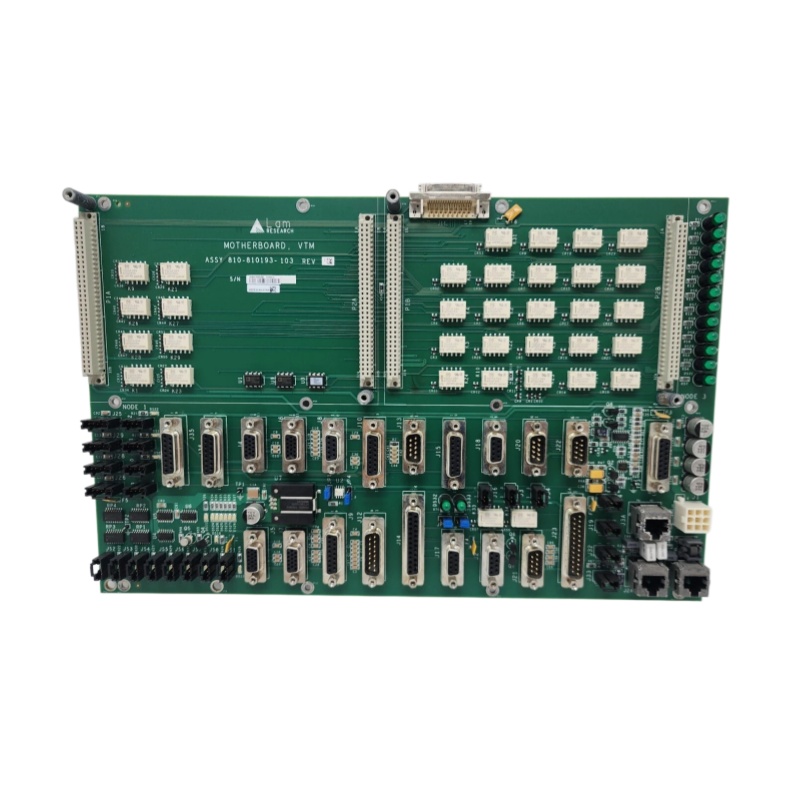
The Lam Research 810-810193-103 is a precision heater assembly engineered to meet the stringent thermal management requirements of semiconductor manufacturing equipment. It serves as a core actuation component within the temperature control subsystem of Lam Research etching and deposition tools. Its primary function is to convert electrical energy into thermal energy and accurately transfer heat to critical components including reaction chamber walls, gas delivery pipelines, and wafer chucks (electrostatic chucks) via high-efficiency thermal conduction interfaces, maintaining the precise operating temperatures required for manufacturing processes.
In plasma etching processes, the stability of chamber wall temperature directly governs the adsorption and volatilization balance of reaction by-products, while the consistency of gas pipeline temperatures prevents flow deviation caused by precursor condensation before process gases reach the reaction zone. Accordingly, the temperature control accuracy and reliability of this heater assembly are critical to process repeatability.
Fabricated with high-quality resistive heating elements and thermally conductive insulating materials through lamination or integral casting processes, the Lam Research 810-810193-103 features an outer protective sheath made of high-temperature and chemically resistant stainless steel or Inconel alloy to withstand chemical erosion from cleanroom environments and process gases. The assembly is designed with optimized power density distribution to form a uniform temperature field on heated surfaces.
Product Specifications
|
Parameter Name
|
Parameter Value
|
|
Product Model
|
810-810193-103
|
|
Manufacturer
|
Lam Research
|
|
Product Type
|
Precision Heater Assembly
|
|
Heating Element Type
|
Ni-Cr or Fe-Cr-Al alloy resistance wire / etched foil heating element
|
|
Rated Voltage
|
208 VAC / 240 VAC (Standard Configuration)
|
|
Rated Power
|
500 W – 2000 W (Dependent on specific configuration and heating area)
|
|
Insulation Material
|
High-purity Magnesium Oxide (MgO) powder or ceramic fiber
|
|
Sheath Material
|
316L Stainless Steel / Inconel 600 Alloy
|
|
Temperature Sensor Type
|
Integrated Pt100 / Pt1000 RTD, Class A precision
|
|
Maximum Continuous Operating Temperature
|
300°C
|
|
Thermal Response Time
|
T90 < 60 seconds (At rated power)
|
|
Insulation Resistance
|
> 100 MΩ (Tested at 500V DC megohmmeter)
|
|
Dielectric Strength
|
> 1500 VAC, no breakdown within 1 minute
|
|
Electrical Connection
|
High-temperature aviation connector (Amphenol / LEMO series) or flying wire lead-out
|
|
Physical Dimensions
|
Customized based on heating surface shape (circular / rectangular / arc-shaped), thickness: 5-15mm
|
|
Installation Method
|
Bolt compression mounting or thermal adhesive bonding
|
Structure and Composition
The internal structure and manufacturing processes of the Lam Research 810-810193-103 comply with high-grade semiconductor heating component standards. Physically, the assembly is customized into geometric shapes that fit tightly with heated surfaces, including circular discs, rectangular plates, and arc-shaped sheets. Its profile precisely matches the contact surfaces of target components such as chamber wall flanges, gas pipeline elbows, and electrostatic chuck bases.
The outer layer consists of a smooth metal sheath hermetically sealed via precision welding with corrosion-resistant 316L stainless steel or Inconel 600 alloy. This sheath provides robust mechanical protection and acts as an efficient thermal conduction interface to transfer internally generated heat to load components.
Encapsulated inside the sheath is the core heating element, fabricated from high-purity Ni-Cr or Fe-Cr-Al alloy through precision spiral winding or etched foil patterning. Etched foil technology is adopted for large-area heating scenarios, forming uniform resistance patterns on planar substrates to achieve optimized power density distribution.
The resistance elements are fully compacted and encapsulated by high-purity magnesium oxide (MgO) powder or ceramic fiber insulation materials. These inorganic insulating materials deliver excellent thermal conductivity and ultra-high electrical insulation strength, ensuring efficient heat transfer from heating elements to the outer sheath while eliminating electrical leakage risks.
An embedded Pt RTD sensor is installed at designated positions inside the assembly, with independent leads for real-time heater temperature monitoring and signal feedback to the temperature controller. Power leads and sensor signal wires are routed through high-temperature insulating sleeves and shielded cables, terminated with high-reliability aviation connectors for fast, plug-and-play electrical connection with equipment systems.
Key Features and Advantages
1. Superior Heating Uniformity and Temperature Control Precision
Equipped with advanced power density distribution design, the product eliminates local overheating and cold spots common in conventional heaters through refined layout of resistance elements. The tightly coupled high-precision Pt100/RTD sensors minimize temperature feedback delay. Cooperated with external high-precision PID temperature controllers, it achieves a temperature control accuracy of ±0.5°C or better.
Superior thermal uniformity and precise temperature control deliver stable thermal boundary conditions for temperature-sensitive advanced etching and deposition processes, effectively preventing process rate fluctuation and uniformity degradation caused by temperature drift.
2. High Reliability and Long Service Life Design
Optimized for nearly non-stop operation of semiconductor equipment, the heater assembly adopts enhanced material and process designs for maximum reliability. The high-purity MgO insulation layer features outstanding temperature resistance and electrical stability, resisting performance degradation under repeated thermal cycling.
The corrosion-resistant metal sheath and hermetic sealing structure block moisture and chemical gases in cleanroom environments, preventing oxidation and corrosion of internal heating elements. Optimized lead-out structure and anti-vibration mounting ensure stable electrical connection under equipment operating vibration.
With these comprehensive optimizations, the 810-810193-103 delivers a service life of tens of thousands of hours under normal operating conditions, significantly reducing unplanned downtime and maintenance costs caused by heater failure.
3. Fast Thermal Response and Flexible Power Regulation
Featuring low thermal inertia, the heater assembly rapidly responds to output commands from temperature controllers. It enables the equipment thermal system to quickly offset thermal disturbances caused by process switching (such as sudden gas flow changes and RF power loading) and restore key component temperatures to setpoints in minimal time.
Additionally, it supports multiple power regulation modes, including solid-state relay (SSR) PWM regulation and phase-angle regulation. Flexible configuration for different precision requirements maximizes system design versatility for end users.
Application Fields
The Lam Research 810-810193-103 is widely applied in front-end semiconductor manufacturing processes, including dielectric etching, conductor etching, Atomic Layer Deposition (ALD), and Plasma-Enhanced Chemical Vapor Deposition (PECVD). It serves as a standard thermal management component for Lam Research 2300-series etching tools, Flex-series deposition tools, and partial Versys-series cleaning tools.
Typical application scenarios include reaction chamber wall heating, gas delivery pipeline tracing heating, electrostatic chuck (ESC) heating, and chamber isolation valve body heating. The component solves two core pain points in semiconductor mass production:
First, precise maintenance of process temperature windows. In etching processes, chamber wall temperature dominates the adsorption and desorption balance of reaction by-products (e.g., polymers, volatile metal halides). The accurate temperature control of the 810-810193-103 inhibits excessive by-product accumulation on chamber walls, extends Mean Time Between Cleaning (MTBC), and stabilizes gaseous component concentrations in the reaction zone, ensuring batch-to-batch consistency of etching rate and selectivity.
Second, reliable thermal guarantee for high-adhesion thin-film deposition. In deposition processes, most precursors tend to condense at low temperatures. By actively heating delivery pipelines and showerheads, the 810-810193-103 ensures stable gaseous precursor delivery to wafer surfaces, eliminating particle contamination and thin-film quality degradation induced by condensation, and providing consistent thermal conditions for high-quality thin-film deposition.